Become a Fan

Help bring the opera to LIFE in NYC by donating today

Tuesday
Aug032010

Blue Ash/Montgomery Symphony to Play "Three Reflections of Sr. Dorothy"

Labor Day, 9/6 at 6PM in the Blue Ash Towne Square. Hear BAMSO perform this work, taken from the opera Angel of the Amazon, with conductor Michael Chertock and Mezzo Soprano, Catherine Fishlock.

Admission is Free.


Tuesday
Jan052010

About the Opera

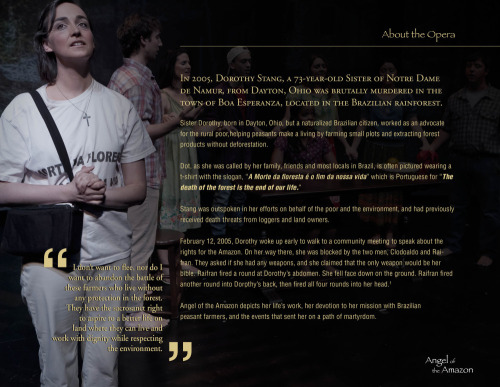
In 2005, Dorothy Stang, a 73-year-old Sister of Notre Dame de Namur, from Dayton, Ohio was brutally murdered in the town of Boa Esperanza, located in the Brazilian rainforest.

Paid by the owner of a logging company, two gunmen shot Dorothy six times as she read the Beatitudes. 

Angel of the Amazon depicts her life’s work, her devotion to her mission with Brazilian peasant farmers, and the events that sent her on a path of martyrdom. 

Its Conception

In late 2005, I attended a lecture at St. Anthony Church in Madisonville, OH. The speaker told a story of a nun in the Brazilian Amazon who had been murdered in February of that year. What struck me was that Sister Dorothy met her gunmen the day before, fed them, prayed with them, and showed them her work with the peasant farmers of the area. When the gunmen showed up the next day, Sr. Dorothy opened her bible, said, "This is my only weapon," and started reading the Beatitudes...Blessed are the poor for theirs is the Kingdom, Blessed are the...and she was shot six times. She was 73.

As soon as I heard that story, I thought, "This NEEDS to be an opera." 

There have been remarkable biographies on Sr. Dorothy, especially by Sr. Roseanne Murphy, Binka Le Breton, Michele Murdock, and the documentary film by Daniel Junge "They Killed Sr. Dorothy." My goal was to recreate her life and mission through music, with hopes that the opera would inspire audiences to help continue the spirit of her work.

This was a challenge. How do you take forty years of work and put it into a two act opera? I had access to Sr. Dorothy's letters from 1969 until one week before her murder. I noticed reoccurring cycles in her mission: As her mission grew, so did the forces to stop her. This cyclical nature became the main dramatic artifice for the opera. I noticed her language changed as well. Her early letters, fairly innocuous, gradually became harsher, more urgent in tone. "Land owners" became "Land Sharks," became "Land Sharks" became "Invaders." I also noticed that Portuguese words crept more and more into her letters. This fact became important both musically and dramatically. Her musical language in the beginning of the opera is very "Western," as the opera progresses, Brazilian rhythms and music enter her musical language and eventually becomes fully integrated as she assumes the role of leader and martyr. 

The opera is scored for Piano, Marimba, Guitar, Two Violins, and Two Celli, a choice made out of artistic and practical needs. It is 90-100 minutes in length in two acts.

Thursday
Jul172008

Highlights from the Opera

Have I Not Wept

Freedom to Fail

Brazilian Farmer's Song

Ten Long Years

Bring on the Rain

Luiz's Soliloquy

The Mountain Top

Will They Listen?